Digestive System
Description
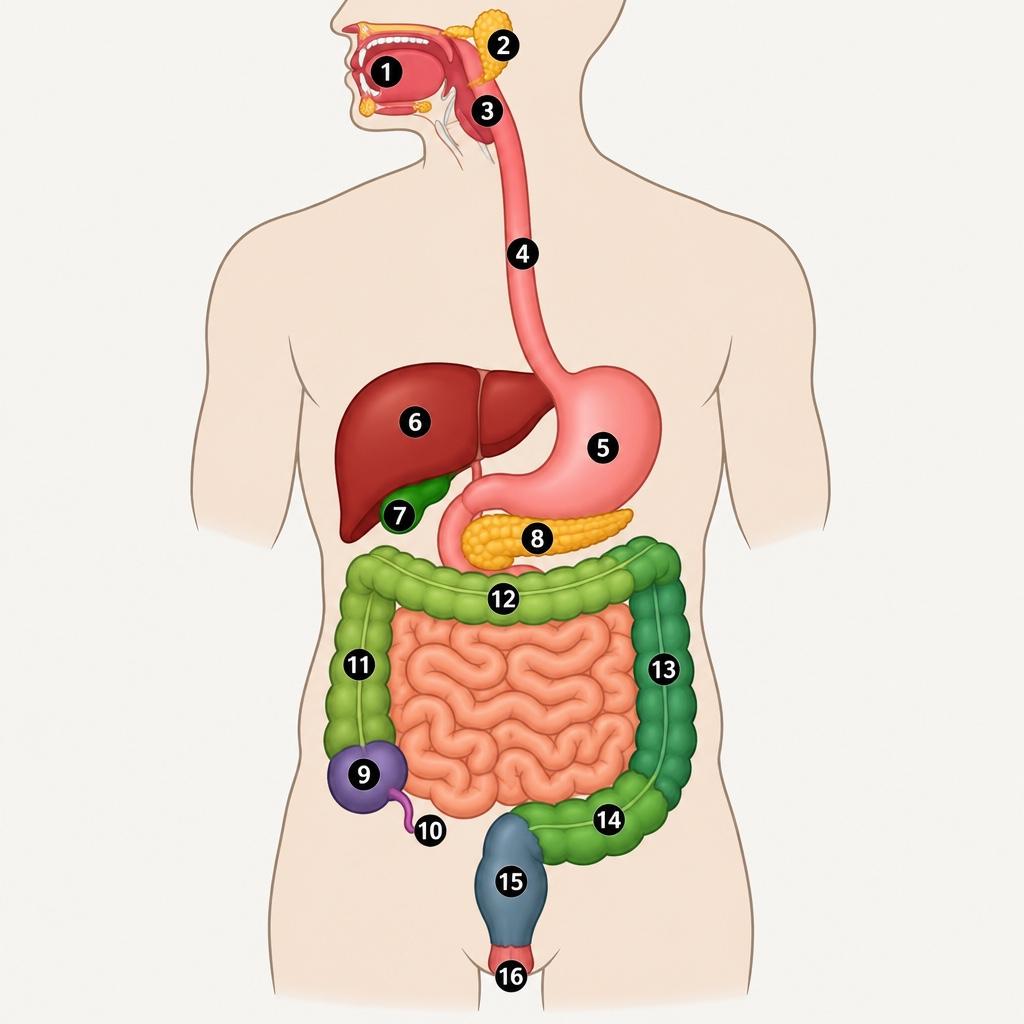
The primary organs, accessory glands, and intestinal divisions of the human gastrointestinal tract.
- Mouth: The opening where mechanical digestion begins with chewing and chemical breakdown starts with saliva.
- Salivary glands: Exocrine glands around the mouth that secrete saliva containing digestive enzymes.
- Pharynx: The muscular tube behind the mouth and nasal cavity that connects to the esophagus.
- Esophagus: The muscular tube that conveys swallowed food from the pharynx down to the stomach via peristalsis.
- Stomach: The J-shaped muscular organ that churns food and secretes acid and enzymes for chemical digestion.
- Liver: The large gland that processes nutrients, detoxifies chemicals, and produces bile.
- Gallbladder: The small pear-shaped organ that stores and concentrates bile before releasing it into the duodenum.
- Pancreas: The gland that secretes digestive enzymes into the small intestine and hormones into the bloodstream.
- Cecum: The blind pouch at the start of the large intestine receiving digested material from the ileum.
- Appendix: A narrow, finger-shaped blind tube projecting from the cecum.
- Ascending colon: The segment of the large intestine that carries waste upward along the right side of the abdomen.
- Transverse colon: The horizontal segment of the large intestine crossing the upper abdomen from right to left.
- Descending colon: The segment of the large intestine that transports waste downward along the left side of the abdomen.
- Sigmoid colon: The S-shaped curve of the large intestine that connects the descending colon to the rectum.
- Rectum: The terminal straight segment of the large intestine where feces are stored prior to expulsion.
- Anus: The external opening of the digestive tract controlled by sphincter muscles to expel waste.
14 Terms
 More Anatomy Khartys