Internal Bones of the Skull
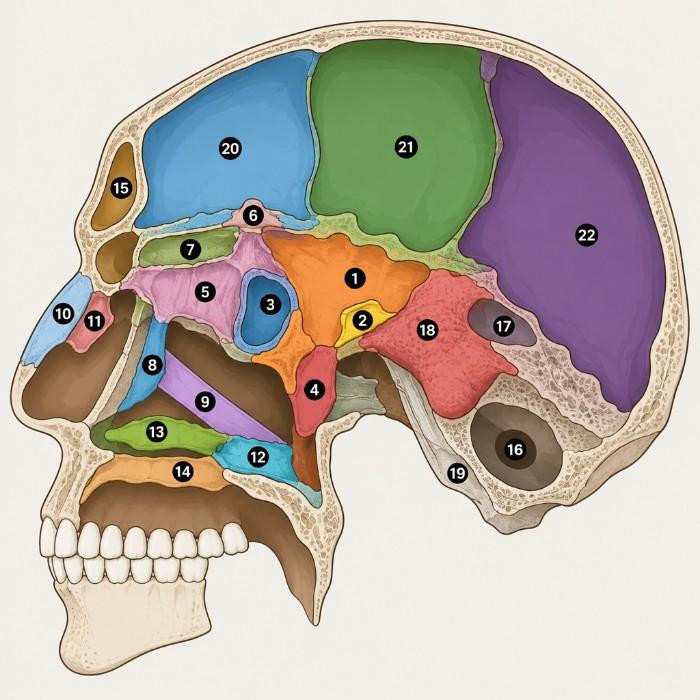
Description
Internal cranial and facial bones, processes, and landmarks visible in a hemisected skull.
- Sphenoid Bone: Butterfly-shaped central bone of the cranial base containing the sphenoidal sinus.
- Sella Turcica: Saddle-shaped depression in the sphenoid body that houses the pituitary gland.
- Sphenoidal Sinus: Air-filled hollow cavity inside the body of the sphenoid bone.
- Pterygoid Process: Downward-projecting plate of the sphenoid bone providing attachment for jaw muscles.
- Ethmoid Bone: Porous bone separating the nasal cavity from the cranial cavity.
- Crista Galli: Vertical crest on the superior surface of the ethmoid anchoring the falx cerebri.
- Cribriform Plate: Horizontal perforated plate of the ethmoid through which olfactory nerve fibres pass.
- Perpendicular Plate of Ethmoid: Thin vertical sheet of the ethmoid that forms the upper part of the bony nasal septum.
- Vomer: Thin, plowshare-shaped bone forming the posteroinferior part of the nasal septum.
- Nasal Bone: Small oblong bone forming the bridge of the nose.
- Lacrimal Bone: Small, fragile bone located on the medial wall of the orbit and lateral nasal wall.
- Palatine Bone: L-shaped bone forming the posterior hard palate and lateral nasal wall.
- Inferior Nasal Concha: Independent curved bone projecting horizontally into the lower nasal cavity.
- Palatine Process of Maxilla: Horizontal shelf of the upper jawbone forming the anterior two-thirds of the hard palate.
- Frontal Sinus: Paired air cavity situated within the frontal bone above each eye socket.
- Foramen Magnum: Large oval opening in the occipital bone through which the spinal cord enters the skull.
- Internal Acoustic Meatus: Canal in the petrous part of the temporal bone transmitting the facial and vestibulocochlear nerves.
- Petrous Part of Temporal Bone: Dense wedge of the temporal bone housing the inner ear structures.
- Hypoglossal Canal: Bony passage above the occipital condyle transmitting the twelfth cranial nerve.
- Anterior Cranial Fossa: Shallowest cranial depression supporting the frontal lobes of the cerebrum.
- Middle Cranial Fossa: Central cranial depression accommodating the temporal lobes of the brain.
- Posterior Cranial Fossa: Deepest and largest cranial fossa containing the cerebellum and brainstem.
22 Terms
 More Anatomy Khartys