Human Nervous System
Description
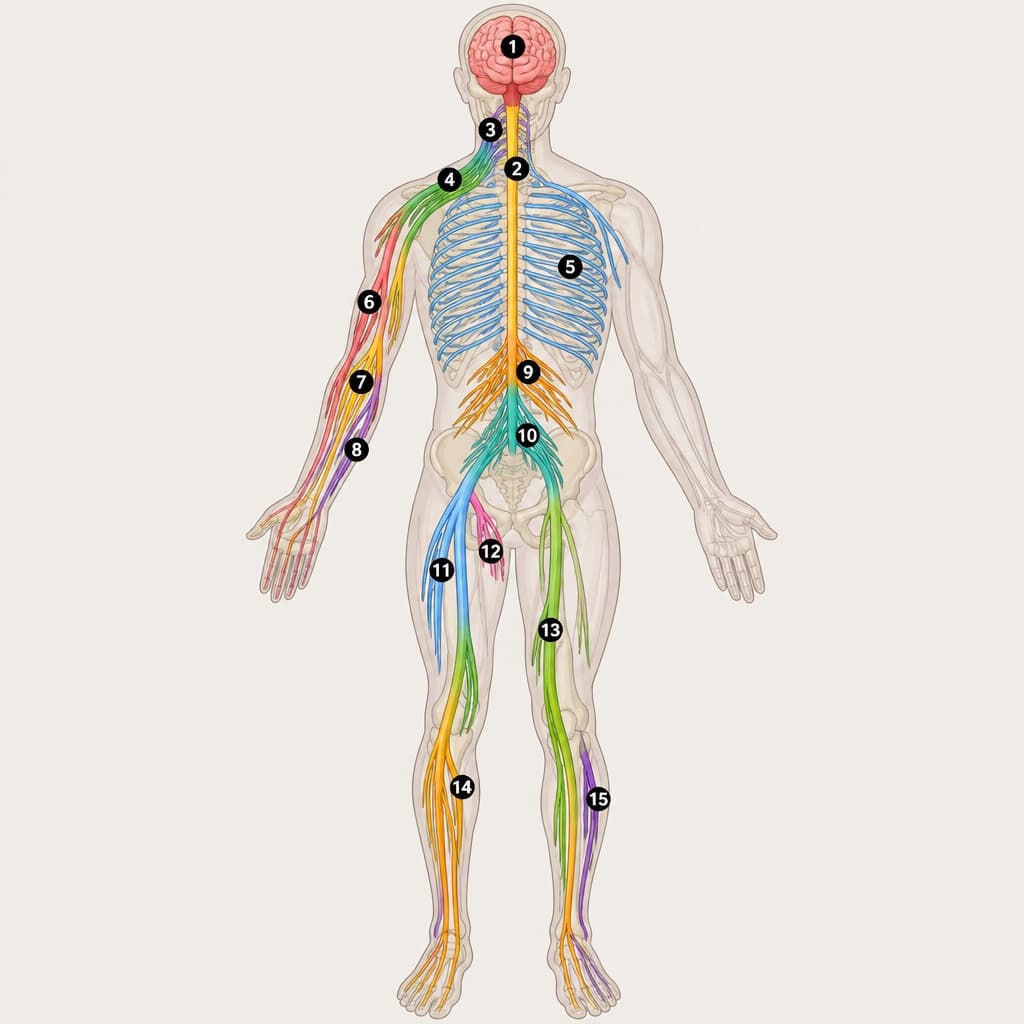
The central and major peripheral nerves of the human body from head to limbs.
- Brain: Central control organ of the nervous system housed within the cranium.
- Spinal cord: Cylindrical bundle of nerve fibers extending down the vertebral canal from the brainstem.
- Cervical plexus: Network of nerve fibers formed by the ventral rami of the upper cervical spinal nerves.
- Brachial plexus: Network of nerves originating in the neck and passing into the axilla to innervate the upper limb.
- Intercostal nerves: Somatic nerves arising from thoracic spinal nerves extending along the ribs.
- Radial nerve: Major nerve of the upper limb innervating posterior arm and forearm muscles.
- Median nerve: Primary nerve extending down the middle of the anterior forearm to the hand.
- Ulnar nerve: Nerve running near the ulna innervating intrinsic hand muscles and the medial side of the hand.
- Lumbar plexus: Nerve plexus in the lower back formed by the ventral rami of lumbar nerves.
- Sacral plexus: Nerve plexus arising from the lower lumbar and sacral spinal nerves.
- Femoral nerve: Largest nerve of the lumbar plexus, innervating anterior thigh muscles.
- Obturator nerve: Nerve arising from the lumbar plexus supplying the adductor muscles of the thigh.
- Sciatic nerve: Thickest and longest nerve in the human body, passing down the posterior thigh.
- Tibial nerve: Terminal branch of the sciatic nerve continuing down the posterior calf to the sole of the foot.
- Common fibular nerve: Branch of the sciatic nerve winding around the neck of the fibula to supply the anterior and lateral lower leg.
15 Terms
 More Anatomy Khartys