Dental Surgical Instruments
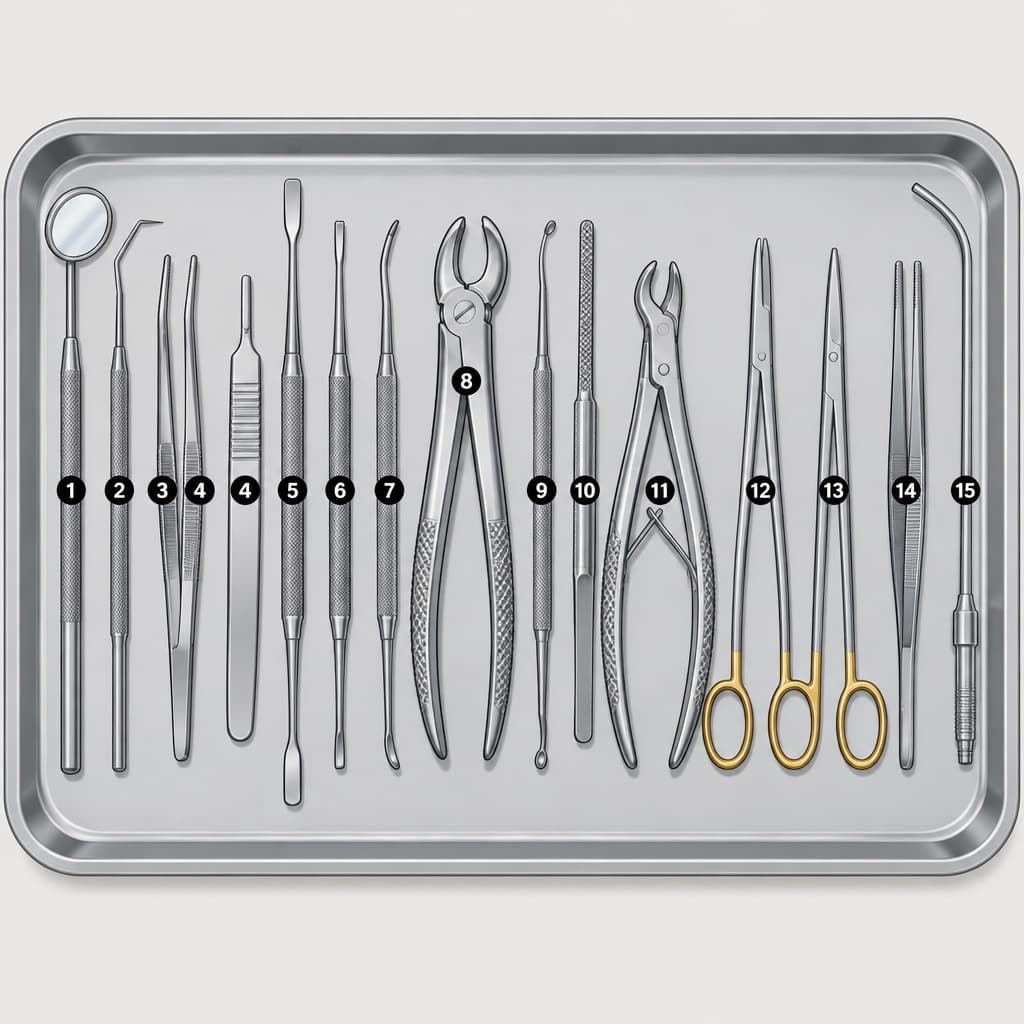
Description
Essential instruments used in oral surgery and tooth extraction arranged on a surgical tray.
- Mouth mirror: Small round mirror used for indirect vision, retraction of soft tissues, and reflecting light.
- Dental explorer: Sharp probe used to detect decay, calculus, and examine margins.
- Cotton forceps: Angled tweezers used to transfer small materials, gauze, and pellets in and out of the oral cavity.
- Scalpel handle: Handle holding disposable surgical blades used to incise oral mucosa and gingiva.
- Periosteal elevator: Double-ended tool used to detach the periosteum and gingiva from the underlying alveolar bone.
- Straight elevator: Leverage instrument used to luxate teeth and expand the alveolar socket prior to forceps extraction.
- Cryer elevator: Triangular-tipped elevator used to remove broken roots from multi-rooted tooth sockets.
- Dental extraction forceps: Pliers-like instrument used to grasp and deliver the tooth from its alveolar socket.
- Surgical curette: Spoon-shaped instrument used to debride granulomas, cysts, or debris from an extraction socket.
- Bone file: Double-ended rasp used to smooth rough edges of alveolar bone before closure.
- Rongeur forceps: Heavy spring-loaded cutting pliers used to trim and remove sharp pieces of alveolar bone.
- Needle holder: Locking forceps used to grasp and drive the suture needle during wound closure.
- Suture scissors: Scissors designed to cut suture threads without snagging surrounding tissue.
- Tissue forceps: Non-locking tweezers, often toothed, used to stabilize soft tissue flaps during dissection and suturing.
- Surgical suction tip: Narrow metal tube connected to high-volume evacuation to clear blood, saliva, and bone fragments.
15 Terms
 More Anatomy Khartys